| USB-C to USB-C |
5 V DC; commonly 1.5–3 A for small rechargeable devices |
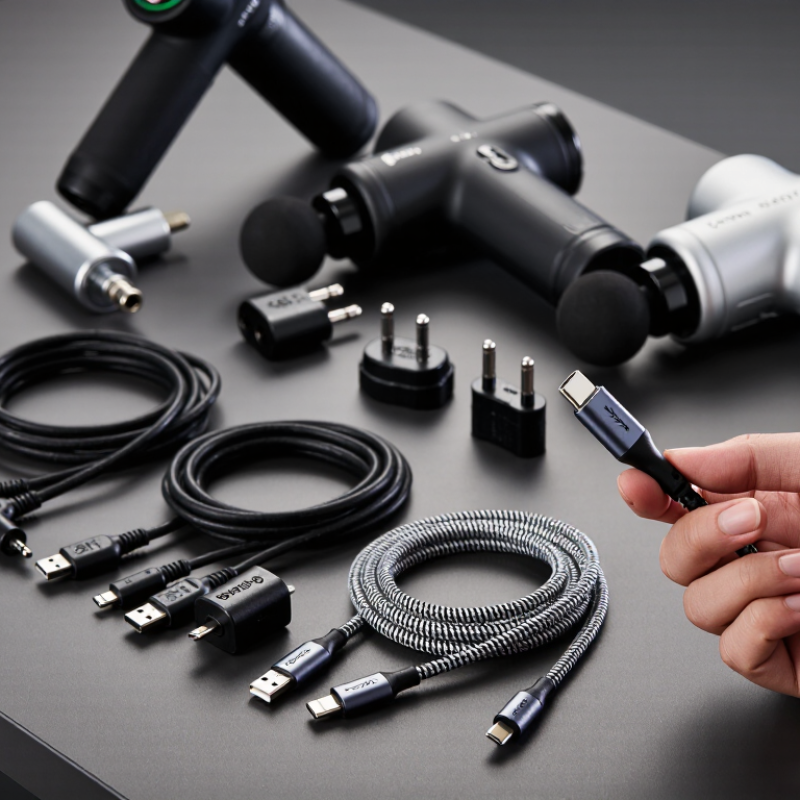
USB-C plug on both ends; confirm that the massage gun accepts USB-C input and that the charger supports the required current |
Over-current and short-circuit protection recommended |
24–28 AWG power conductors, molded strain relief, abrasion-resistant outer jacket |
Check connector fit, cable temperature during charging, insulation quality, and USB-C compliance information |
Newer massage guns and universal travel charging kits |
| USB-A to USB-C |
5 V DC; typically up to 2–3 A depending on the power source and cable design |
USB-A source plug with USB-C device plug; charging speed depends on the adapter, cable, and device |
Basic protection with controlled current delivery |
Low-resistance copper conductors, reinforced plug housings, flexible PVC or TPE jacket |
Verify that the cable does not rely on unsupported fast-charging claims and that the connector remains secure |
Existing USB wall adapters, computers, power banks, and vehicle chargers |
| USB-A to Micro-USB |
5 V DC; commonly 1–2 A for older rechargeable equipment |
Micro-USB plug orientation must be correct; the connector is not reversible |
Basic over-voltage and short-circuit protection recommended |
Flexible cable jacket, reinforced neck, corrosion-resistant contacts, secure molded housing |
Inspect for loose fit, bent contacts, excessive connector movement, and charging interruption |
Older massage gun models using Micro-USB charging ports |
| USB-A to DC Barrel Plug |
Usually 5 V DC, but the exact voltage and polarity must match the device label |
Barrel size, center polarity, and plug dimensions must be verified before use |
Polarity and voltage matching are critical |
Clear polarity marking, molded plug, strain relief, and copper conductors sized for the current |
Confirm the plug inner diameter, outer diameter, center-positive or center-negative polarity, and output voltage |
Massage guns supplied with a proprietary DC charging input |
| AC Adapter with Detachable Charging Cord |
Input commonly 100–240 V AC; output must match the massage gun specification |
Separate adapter and cord can simplify replacement, but both parts must be electrically compatible |
Over-voltage, over-current, thermal, and short-circuit protection preferred |
Double-insulated cable, flame-retardant jacket, robust adapter connection, and secure strain relief |
Look for input/output markings, electrical safety approvals applicable to the destination market, and clear user instructions |
International distribution where mains-voltage compatibility is required |
| Travel Charging Cord |
Low-voltage USB charging, normally 5 V DC; power source may vary by country |
Use with a certified local adapter or a compliant universal power adapter |
Short-circuit protection and temperature control recommended |
Compact flexible jacket, tangle resistance, reinforced connectors, and adequate bend-cycle durability |
Confirm compatibility with local plug adapters, airline or transport requirements, and destination voltage systems |
Business travel, sports travel, hospitality, and international e-commerce orders |
| High-Flex Replacement Cord |
Electrical rating must equal or exceed the original charging cord specification |
Connector dimensions and wiring configuration must match the original device |
Mechanical protection is especially important |
Fine-stranded copper wire, braided or TPE outer jacket, flexible boot, and tested bend resistance |
Evaluate repeated-bending performance, connector retention, conductor continuity, and jacket cracking |
Fitness centers, physical therapy facilities, rental equipment, and frequent daily use |
| Long-Reach Charging Cord |
Use the same voltage and current requirements as the original cord; longer length may increase resistance |
Connector type must match the charging port; avoid excessive length for low-power devices unless tested |
Monitor voltage drop and heat during extended charging |
Lower-resistance conductors, quality shielding where applicable, and reinforced cable ends |
Test charging stability at full cable length and check for warm plugs or intermittent charging |
Hotel rooms, clinics, offices, bedside use, and equipment stored away from outlets |
| Multi-Country Replacement Set |
Charging cord output must match the device; interchangeable wall plugs must match local sockets |
Use region-specific plug adapters rather than forcing incompatible plugs into outlets |
Fuse or overload protection in the adapter is preferred |
Clearly marked cords, secure plug modules, flame-retardant materials, and durable storage case |
Check plug compatibility for the destination country and verify that adapters are rated for local mains voltage |
Global buyers, distributors, corporate travel programs, and export bundles |
| Commercial-Duty Charging Cord |
Must meet the original device voltage and current requirements; select higher durability rather than higher voltage |
Use a connector with strong retention and resistance to repeated insertion and removal |
Thermal, over-current, and short-circuit protection recommended |
High-strand-count copper, thick flexible jacket, reinforced strain relief, and documented durability testing |
Review batch consistency, continuity testing, insulation testing, packaging protection, and replacement availability |
Gyms, spas, clinics, hotels, and other high-frequency charging environments |