Choosing Solar Inverters And Battery Storage is not simply a matter of comparing prices. The right system must match your roof, electricity use, climate, and backup expectations. A family using 12 kilowatt-hours each evening needs a different design from a workshop running pumps and compressors. Those details matter.
Dr. Imre Gyuk, a longtime U.S. Department of Energy energy-storage expert, has called storage “a game changer for the electric grid.” His observation highlights an important point: the inverter and battery must operate as one dependable system. A high-efficiency inverter may still disappoint if its battery communication, backup switching, or installation design is poor. Check continuous power, surge capacity, usable battery capacity, round-trip efficiency, operating temperature, and warranty conditions. Do not rely on headline capacity alone.
Small details become visible during a blackout. Can the system start a refrigerator? Will it power a heating pump at night? Does it keep essential circuits separate from heavy loads? A qualified installer should explain these answers clearly and provide realistic production estimates. Independent certifications, transparent warranty terms, monitoring access, and documented installation experience also support a trustworthy decision.
The process is rarely perfect. Household demand changes, batteries degrade, and solar forecasts remain uncertain. Oversizing may waste money, while undersizing can create frustration during cloudy weeks. This guide explores practical trade-offs between string and hybrid inverters, lithium battery systems, backup performance, safety, maintenance, and long-term value. The best choice is not the most impressive specification. It is the system that performs reliably in your actual home.
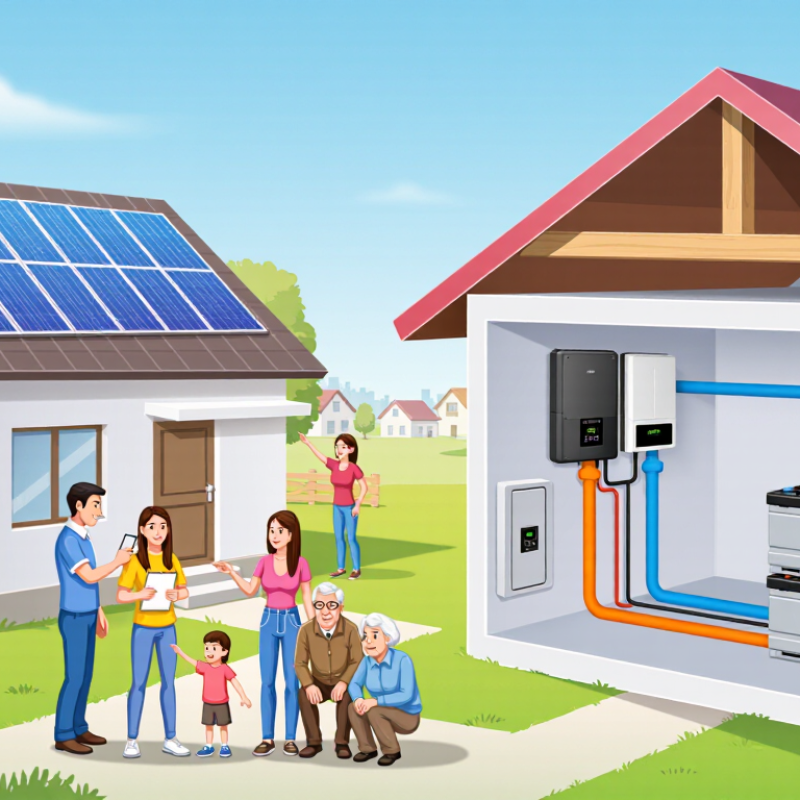
Solar inverters are the control center of a photovoltaic system. Their main job is converting direct current from panels into usable alternating current for household appliances. They also monitor voltage, frequency, and system output. A string inverter connects several panels in one circuit, making it practical and cost-effective for clear, unshaded roofs. Microinverters work behind individual panels, which can improve performance when shadows affect only part of the roof.
Hybrid inverters add battery control to solar conversion. They decide whether solar energy should power appliances, charge the battery, or flow to the grid. Many models include maximum power point tracking, often called MPPT, to extract energy as sunlight changes. An experienced installer should check roof direction, panel layout, local grid rules, and expected evening demand. A larger inverter is not automatically better. Oversizing can increase cost without improving daily performance. I would recheck these calculations, especially when future battery expansion is planned.
Tips: Compare the inverter’s continuous output with your real household load. Check surge capacity for pumps, refrigerators, or workshop tools. Ask about operating temperature, monitoring accuracy, warranty terms, and repair access. Keep batteries and inverters in a dry, ventilated location. Do not ignore shading. One shaded panel can reveal weaknesses in a poorly planned string system.
Sizing begins with your electricity profile, not the inverter’s headline rating. The U.S. Energy Information Administration reports that average residential electricity use is roughly 10,500 kWh per customer annually. That equals about 29 kWh daily, but homes rarely consume power evenly. Evening cooking, heating, and electric vehicle charging can create sharp peaks.
Review twelve months of utility bills and record your largest hourly loads. A smart meter can reveal whether demand rises at sunset or during cold mornings. The Lawrence Berkeley National Laboratory’s 2024 Tracking the Sun report found that the median residential solar system installed in 2023 was about 7.4 kW. That figure is useful for comparison, not a personal prescription. Roof direction, shading, local weather, and household behavior matter more.
Your inverter must handle continuous demand and short startup surges. Check both rated output and surge capacity. For batteries, estimate essential loads during an outage, then divide their daily energy needs by usable battery capacity. Include conversion losses; round-trip efficiency is never perfect. A 10 kWh battery will not deliver 10 kWh to appliances.
420 GW
solar PV additions reached nearly globally in 2023
Start smaller if your priorities are unclear. My first estimate was too optimistic because I ignored winter heating demand. That mistake matters. The International Energy Agency reports that solar PV additions reached nearly 420 GW globally in 2023, yet local conditions still determine household performance. Recheck your assumptions with seasonal production data and an installer’s documented load analysis.
Choosing storage begins with chemistry, not the advertised capacity. Lithium iron phosphate batteries usually provide strong thermal stability and frequent cycling. Nickel-based lithium batteries can offer higher energy density, but they may require tighter temperature control. Lead-acid systems cost less initially, yet their usable capacity falls when deeply discharged. The U.S. Department of Energy reports that lithium-ion systems commonly achieve round-trip efficiencies above 85%, while lead-acid performance is generally lower.
Usable capacity matters more than the number printed on the cabinet. A 10 kWh battery with an 80% depth-of-discharge limit supplies about 8 kWh before conversion losses. Daily household demand, evening loads, and winter sunlight should shape the calculation. The National Renewable Energy Laboratory’s 2024 cost report models utility-scale lithium-ion storage with roughly 15 years of life, although cycling frequency and heat can shorten that period. Real homes are less predictable.
Lifespan is measured in cycles, years, or both. Some lithium iron phosphate systems reach several thousand cycles under controlled conditions, while lead-acid units may tolerate fewer deep cycles. The International Energy Agency reported that global battery prices fell sharply between 2010 and 2023, improving storage economics, but replacement costs still matter. A larger battery is not always wiser. Oversizing can leave expensive cells idle; undersizing may increase daily stress. I would compare warranty throughput, usable capacity, operating temperature, and end-of-life capacity—not just purchase price.♀♀♀♀
| Battery Technology | Typical Usable Depth of Discharge | Typical Round-Trip Efficiency | Expected Service Life | Typical Cycle Life | Main Advantages | Main Limitations | Suitable Applications |
|---|---|---|---|---|---|---|---|
| Lithium Iron Phosphate (LFP) | 80%–95% | 90%–96% | 10–15 years, depending on temperature, cycling, and warranty conditions | Approximately 3,000–7,000 cycles | High safety, long cycle life, strong usable capacity, low maintenance, and good energy efficiency | Higher upfront cost than many lead-acid systems; performance may be restricted at temperatures below freezing without thermal management | Daily solar self-consumption, backup power, and residential or small commercial energy storage |
| Nickel Manganese Cobalt (NMC) | 80%–90% | 90%–95% | 8–12 years under moderate operating conditions | Approximately 2,000–5,000 cycles | High energy density, compact size, and relatively low weight | Requires robust battery management and thermal protection; generally more sensitive to high temperatures and abuse than LFP | Space-constrained installations, hybrid systems, and applications where compact storage is important |
| Flooded Lead-Acid | 50%–80% | 75%–85% | 3–7 years, depending heavily on maintenance and operating depth | Approximately 500–1,500 cycles | Lower initial purchase cost and established recycling infrastructure | Heavy and bulky; requires ventilation and regular maintenance; deeper discharges significantly reduce lifespan | Low-cost backup systems, occasional-use storage, and installations with adequate ventilation |
| Absorbent Glass Mat (AGM) Lead-Acid | 50%–80% | 75%–85% | 4–8 years under suitable conditions | Approximately 500–1,500 cycles | Sealed construction, low maintenance, and better vibration resistance than flooded lead-acid batteries | Lower energy density and shorter cycle life than most lithium systems; sensitive to repeated deep discharge and high temperatures | Small backup systems, moderate-cycle applications, and locations where low maintenance is preferred |
| Vanadium Redox Flow Battery | 80%–100% | 65%–85% | 15–25 years, with appropriate electrolyte and system maintenance | Often more than 10,000 cycles | Very long cycle life, minimal capacity degradation, and strong suitability for frequent deep cycling | Large physical footprint, higher balance-of-system complexity, and lower efficiency than lithium-ion systems | Large commercial or utility-scale projects requiring long-duration and frequent cycling |
| Selection Dimension | Recommended Assessment Method | Practical Guidance |
|---|---|---|
| Daily Energy Consumption | Review at least 12 months of electricity bills or smart-meter data and identify average and peak daily use | Size the battery around the energy that must be shifted or backed up, rather than the total annual household consumption |
| Usable Battery Capacity | Use the manufacturer’s usable capacity, not only the nominal nameplate capacity | For example, a 10 kWh nominal battery with an 90% usable limit provides approximately 9 kWh before conversion losses |
| Battery Sizing Formula | Required nominal capacity = target usable energy ÷ depth of discharge ÷ expected end-to-end efficiency | Allow additional capacity when the battery must cover overnight loads, essential circuits, winter production, or future electricity demand |
| Power Rating | Compare continuous output, short-term peak output, and the starting requirements of motors or pumps | Energy capacity determines how long the system operates; power rating determines which appliances can run simultaneously |
| Solar Inverter Type | Match the inverter architecture to the system’s solar generation, battery, backup, and export requirements | A hybrid inverter can manage solar panels and batteries in one system; an AC-coupled battery inverter can be added to an existing solar installation |
| Inverter Efficiency | Compare weighted or European efficiency, maximum efficiency, standby consumption, and battery charging efficiency | Higher efficiency reduces energy losses, but actual performance also depends on operating load, temperature, and system design |
| DC-to-AC Ratio | Compare the solar array’s DC capacity with the inverter’s AC rating | A moderate DC oversizing ratio can improve morning, evening, and low-light production, but excessive oversizing may increase clipping and exceed equipment limits |
| Backup Capability | Check whether the inverter supports backup output, automatic transfer, islanding protection, and whole-home or selected-load operation | Confirm that the backup output can support essential loads and motor-starting surges during a grid outage |
| Operating Temperature | Review the battery and inverter operating-temperature ranges and any heating or cooling requirements | High temperatures accelerate battery aging; some lithium batteries require a heating strategy before charging below freezing |
| Warranty and Retained Capacity | Compare warranty duration, cycle or throughput limits, operating conditions, and guaranteed end-of-warranty capacity | Look for a clearly stated retained-capacity value, commonly expressed as a percentage of the original capacity after a defined period or energy throughput |
| Safety and Installation | Verify required clearances, ventilation, battery management, protective devices, and local electrical-code compliance | Use qualified installers and place batteries away from flooding, excessive heat, direct sunlight, and combustible materials |
| Future Expansion | Check whether additional battery modules can be added and whether the inverter supports the planned maximum capacity | Choose compatible voltage ranges, communication protocols, protection devices, and installation space before purchasing |
A compatible solar system begins with electrical matching, not attractive capacity figures. Check the battery’s nominal voltage and operating range against the inverter’s battery input range. A 48-volt battery may exceed its limits during full charging. That detail matters.
Compare continuous charge and discharge current, then check short-term peak current. The inverter may demand more power during motor startup or backup switching. Battery capacity also needs realistic sizing. A 10 kWh battery cannot safely deliver every kilowatt-hour if its usable depth of discharge is limited. Review the battery’s continuous C-rate and the inverter’s maximum DC current.
Communication is equally important. Some systems require CAN or RS485 communication for state-of-charge readings, charging limits, and fault protection. Without the correct protocol or firmware, the inverter may operate conservatively or stop altogether. A battery can fit physically but fail electrically. I have seen specifications that looked compatible until the charge-current limit was checked closely.
Consider backup loads, too. Refrigerators, pumps, and heaters create different surge demands. Select an inverter with suitable continuous and peak output, while confirming the battery can support that demand. Inspect cable size, fuses, isolators, grounding, and installation temperature. Manuals are more reliable than sales charts. Still, manuals can be unclear. Ask a qualified installer to verify the complete design, local grid requirements, and battery safety certifications before installation.
How to Choose Solar Inverters and Battery Storage?
Safety should guide every inverter and battery decision. Check certified protection against overheating, short circuits, moisture, and electrical surges. Battery placement matters too. Keep storage away from bedrooms, heat sources, and blocked escape routes. A qualified electrician should verify wiring, ventilation, grounding, and shutdown access under local electrical rules. Never rely only on a product label.
Efficiency needs a practical view. Compare conversion efficiency, standby consumption, usable battery capacity, and performance during partial loads. A larger battery is not automatically better. Oversizing can increase purchase costs while leaving stored energy unused. Review your evening demand, cloudy-day patterns, and backup priorities. A ten-minute load audit may reveal more than a glossy calculator.
Costs include more than installation. Allow for permits, protective equipment, monitoring, replacement parts, and future battery degradation. Ask how warranties handle capacity loss and service delays. Maintenance should include firmware checks, connection inspections, temperature monitoring, and an emergency procedure. The cheapest proposal may hide difficult access or limited support. That happened in one assessment. The spreadsheet looked convincing, yet the maintenance route was unsafe. Reconsider assumptions. A resilient system balances safety, efficiency, transparent costs, and realistic long-term care.
Evaluating Safety, Efficiency, Costs, and Long-Term Maintenance
The chart uses a 0–100 benchmark index based on typical residential technology ranges. LFP batteries generally provide stronger thermal stability and longer cycle life, while NMC batteries can offer higher energy density. DC-coupled hybrid systems usually reduce conversion losses, whereas AC-coupled systems can be easier to add to an existing solar installation. Actual performance, installed cost, and maintenance requirements vary with system design, climate, installation quality, and operating conditions.