How to Choose the Best Solar House Battery System?
Choosing the best Solar House Battery System requires more than comparing storage capacity and prices. It involves understanding how your household produces, uses, and saves energy each day. A family with evening cooking, electric heating, and an electric vehicle may need different equipment from a small home with modest overnight demand. Solar generation also changes with seasons, roof direction, shading, and local weather.
Practical experience shows that battery size is only one part of the decision. Usable capacity, continuous power output, battery chemistry, charging speed, backup performance, and expected lifespan deserve careful attention. A 10 kWh battery may sound impressive, but its usable energy could be lower after reserve limits and system losses. That detail is easy to miss.
This guide examines how to compare system specifications, warranties, installation requirements, safety features, and monitoring software. It also considers whether the battery integrates with your solar inverter and household electrical panel. Manufacturer documentation and recognized safety certifications provide useful evidence, while an assessment from a qualified installer adds site-specific knowledge. Local grid requirements should also be checked before installation.
Real homes are rarely perfect test environments. Clouds arrive unexpectedly. Energy habits change. Even expert estimates can miss future demand. For that reason, the best choice should balance current needs, expansion options, budget, and long-term reliability. A careful decision may cost more initially, yet poor sizing can create greater frustration later. This article offers a practical framework, while acknowledging that no single Solar House Battery System suits every property.
Define Household Loads and Size Battery Capacity from Daily kWh Demand
How to Choose the Best Solar House Battery System?
Battery sizing starts with household loads, not battery marketing. List every appliance, its wattage, and daily runtime. Refrigerators, pumps, electric water heaters, and heating equipment can dominate consumption. The U.S. Energy Information Administration reported average residential electricity use of about 10,715 kWh annually in 2020, or nearly 29 kWh per day. Your home may differ sharply. Measure it.
Create two load profiles: essential and flexible. Essential loads include lighting, refrigeration, communications, and medical equipment. Flexible loads can wait for sunlight. Add their daily energy use in kilowatt-hours. For example, 12 kWh of essential demand over 1.5 days requires 18 kWh of delivered energy. With 90% usable depth of discharge and 90% round-trip efficiency, nominal storage becomes about 22 kWh. The calculation is simple, but assumptions matter.
NREL battery-storage modeling commonly uses round-trip efficiency near 85–90%, showing why nameplate capacity can overstate usable energy. Peak power also needs separate checking. A pump may consume little daily energy but draw high starting power. Oversizing is costly. Undersizing is frustrating. Review winter demand, cloudy-day recharge, and battery aging before deciding. I would also keep a measurement margin of 10–20%; household behavior is rarely as tidy as a spreadsheet. Industry reports provide useful averages, but your meter provides better evidence.
Compare LiFePO₄ and NMC by Safety, Energy Density, and Cycle Life
How to Choose the Best Solar House Battery System?
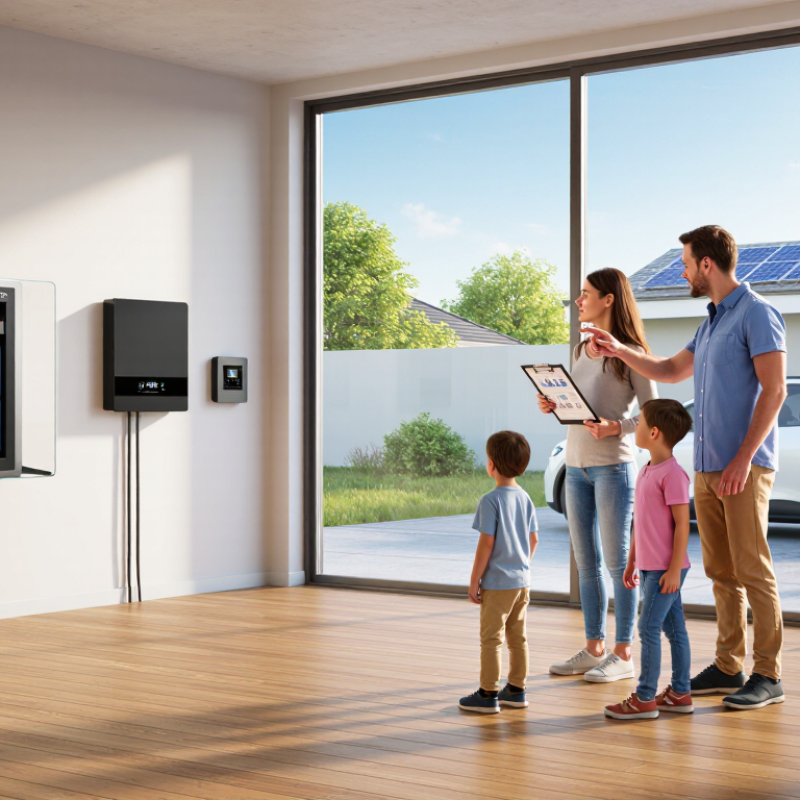
Choosing a home battery means balancing safety, usable capacity, and long-term value.
LiFePO₄ batteries generally offer stronger thermal stability than NMC chemistry. Their cells are less likely to overheat during abuse or charging faults. That matters in a garage, utility room, or outdoor cabinet. Still, safe installation depends on proper ventilation, wiring, fuses, and battery management controls. Chemistry alone cannot prevent every failure.
NMC batteries usually provide higher energy density.
A smaller, lighter pack may store more energy, which helps when space is limited. LiFePO₄ packs are often larger for the same rated capacity. However, they commonly deliver a longer cycle life under suitable operating conditions. For daily solar charging, that difference can affect replacement costs over several years. Check usable capacity, not only the advertised capacity. Reserve limits may reduce the energy available at night.
Ask for independent safety testing, clear cycle-life conditions, and a detailed warranty.
Cycle claims can change with temperature, discharge depth, and charging speed. A battery rated for thousands of cycles may perform differently in a hot, poorly ventilated room. Keep the unit away from water, heat sources, and living areas when possible. A professional installer should verify load calculations and emergency shutdown access. I would not choose purely by price. That shortcut often hides installation quality and future service problems. Reliability is rarely the cheapest line on the quote.
Assess 80–95% Round-Trip Efficiency and 80–100% Usable Depth of Discharge
When choosing a solar house battery system, examine round-trip efficiency, not just the advertised capacity. This figure shows how much energy remains after charging and discharging. An 80–95% rating means 8–9.5 kWh may return from every 10 kWh stored. The result changes with temperature, inverter losses, cable resistance, and standby consumption. Ask for tested performance under realistic household conditions.
Usable depth of discharge, or DoD, shows how much of the battery can be safely used. A system rated at 80–100% DoD may provide nearly all its nominal capacity, but daily operation at the maximum can increase stress. For example, a 10 kWh battery with 90% usable DoD and 90% round-trip efficiency may deliver about 8.1 kWh from stored solar energy. Check whether the stated capacity includes reserve energy. It often does not.
I compare these figures with evening loads, not ideal laboratory charts. A refrigerator, lights, router, and induction cooker can create sharp demand peaks. The battery should cover normal usage without relying on its final reserve every night. I also review warranty conditions, operating temperatures, cycle testing, and degradation assumptions. My first estimate was too optimistic because I ignored winter heating demand. That mistake matters. Independent test data is more useful than a confident sales claim, especially when efficiency and usable capacity are measured under different conditions.
How to Choose the Best Solar House Battery System?
Compare the typical planning ranges for round-trip efficiency and usable depth of discharge before selecting a residential battery system.
Higher round-trip efficiency reduces energy losses, while greater usable depth of discharge provides more usable storage capacity. Actual performance depends on battery chemistry, inverter losses, temperature, power level, reserve settings, and system age.
Check Inverter Power, Backup Loads, Warranty, and 10-Year Performance
How to Choose the Best Solar House Battery System?
Choosing a home battery starts with inverter power, not storage capacity alone. A large battery cannot help if the inverter delivers limited output. Check its continuous and surge ratings carefully. A refrigerator may need extra power when its compressor starts. Pumps and electric heaters can create similar demands.
List the backup loads you genuinely need. During an outage, essential circuits might include lights, internet equipment, refrigeration, and medical devices. Avoid connecting every appliance without checking the system’s limits. I once saw a homeowner expect a battery to run an oven and water heater together. That assumption was wrong. A simple load test can reveal the problem before installation.
Warranty wording deserves close attention. Look for coverage years, energy throughput limits, retained capacity, and service conditions. A ten-year warranty sounds reassuring, but the details matter more. Ask how performance is measured after ten years. Heat, frequent deep cycling, and poor ventilation can reduce real-world output. Review the installation manual and local electrical requirements with a qualified installer. Keep records of commissioning data and annual performance checks. Small records help.
Compare usable capacity, not only the advertised battery size. A battery rated at 10 kilowatt-hours may provide less usable energy after reserve limits and conversion losses. Estimate your evening consumption from actual bills or monitoring data. Recheck those figures after changing appliances. Household habits rarely stay fixed. That part is easy to underestimate.